Snow Full Trippy Video Experience. Getting Involved. Psychedelic Kaleidoscopic Hallucinating Visuals
Wonder this video in a big full screen.
Let yourself be enveloped by the magic of this psychedelic and kaleidoscopic video, created to immerse you in its atmosphere. This is the full experience of a
Hypnotic Psytrance Full Coloured Experience Mystic Rainbow Trippy Video
The purest techno psytrance with kaleidoscopic visuals... Fly.
El más puro techno psytrance con visuals caleidoscópicos... Vuela.
#curious #exclusive #pasardelmundo #maketheworldout #nihilist #noi
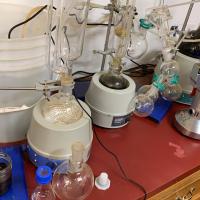
William Leonard Pickard October 21, 1945
William Leonard Pickard studied neurobiology at U.C. Berkeley, and later graduated from the Kennedy School of Government at Harvard with degrees in chemistry ... View MoreWilliam Leonard Pickard October 21, 1945
William Leonard Pickard studied neurobiology at U.C. Berkeley, and later graduated from the Kennedy School of Government at Harvard with degrees in chemistry and public policy. For a couple of years he worked as the deputy director of UCLA's Drug Policy Analysis Program. Within the psychedelic community, Pickard's notoriety stems from his arrests related to illicit drug manufacturing, concluding with the infamous "Kansas missile silo" bust in November of 2000, when he was arrested on charges of conspiracy to distribute LSD and possession with the intent to distribute and dispense LSD. After being found guilty at trial, his partner Clyde Apperson received a thirty-year prison sentence, while Pickard got two life sentences. The arrest came about due to their associate Gordon Todd Skinner, a DEA informant. (In matters not directly related to the missile silo case, Skinner was, himself, later arrested and convicted of assault, kidnapping, and conspiracy charges, receiving a "life plus 90 years" prison sentence.)
In a March 31, 2003 DEA press release it was claimed that the Pickard/Apperson bust represents "the largest LSD lab seizure ever made by the Drug Enforcement Administration", with "approximately 41.3 kilograms" of LSD having been seized. These ideas regarding the magnitude of the lab's LSD production have been widely reported and often repeated, yet they appear to be vast exaggerations. Although a DEA forensic chemist's testimony later revealed that the "actual amount of all the exhibits containing LSD was 198.9 grams of LSD", it has been pointed out by one reporter that even that figure was an extrapolated estimate rather than a known quantity. And despite the November 20, 2003 testimony from the aforementioned DEA chemist, the "approximately 41.3 kilograms" figure remains posted on the DEA's website. Within a paper delivered in absentia at the World Psychedelic Forum in March of 2008, Pickard's own thoughts regarding "International LSD Prevalence - Factors Affecting Proliferation and Control" were voiced.
From behind bars, Pickard continued to fight for his freedom and to draw attention to the ways in which the DEA maintains records on U.S. citizens. In 2011 he published an article about the Narcotics and Dangerous Drugs Information System titled "DEA's NADDIS System: A Guide for Attorneys, the Courts, and Researchers". In July 2020, his term of imprisonment was reduced to time served.
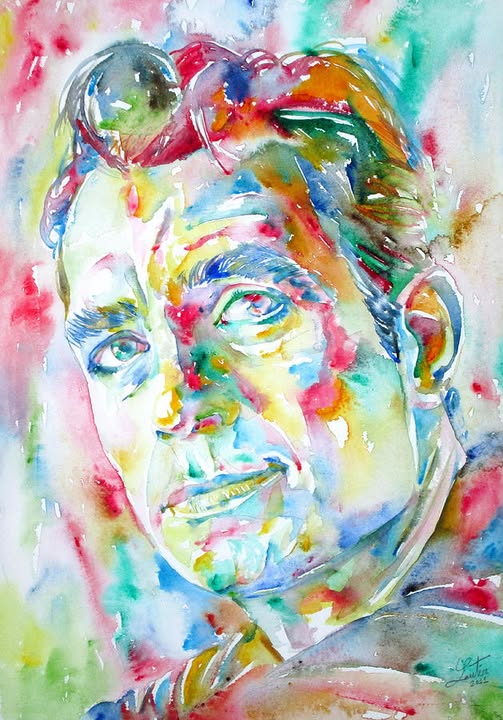
Timothy Francis Leary October 22, 1920 – May 31, 1996
President Richard Nixon once described Leary as “the most dangerous man in America.
Vision of a New Psychology
Timothy Francis Leary was born t... View MoreTimothy Francis Leary October 22, 1920 – May 31, 1996
President Richard Nixon once described Leary as “the most dangerous man in America.
Vision of a New Psychology
Timothy Francis Leary was born to Irish-French immigrants in Springfield, Massachusetts in 1920. His parents and Jesuit school gave him a strict Catholic education. At age 19, he attended the renowned military academy at West Point but left after eighteen months due to disciplinary problems. He began studying psychology at the University of Alabama in 1941 and was awarded a Bachelor of Arts degree two years later. He then worked as a psychologist in an army hospital in Pennsylvania until the end of WWII. After the war he resumed his studies at Washington State University earning his master’s degree in 1946 and obtaining a doctorate in psychology from the University of California at Berkeley in 1950. That same year he set up a department of psychology at Kaiser Foundation Hospital in Oakland, California, where he encountered his college friend, Frank Barron. The two shared many interests, whether a drink together, playing tennis, or a preference for reading James Joyce over Sigmund Freud. (Lattin2010) They carried out a psychotherapy study in 1955 which received wide notice and was much discussed. One third of the one-hundred and fifty patients treated improved, one third remained unchanged, and one third deteriorated. In the control group that received no treatment, the results were the same. The two established psychologists found the results to be sobering and prompted Leary to deeply question the relationship between physician and patient and to explore new psychotherapeutic treatment methods. He finally was promoted to clinic director and published nearly fifty articles which brought him respect in the field.
His book Interpersonal Diagnosis of Personality (Leary 1957), which was based on the analysis of hundreds of group treatment outcomes, presented his method for categorizing patients into different personality types with five levels of inter-personal interaction. Leary did not automatically consider patient behavior that deviated from the norm to be dysfunctional. As long as symptoms of severe illness were not present, he thought such persons should be supported in managing their own lives. With that, Leary challenged the theory of behaviorism which held sway throughout America at the time and limited itself to one-sided observation, measurement, and alteration of behavior patterns. Leary’s book became standard reading for American psychologists and gave him a solid reputation in academic circles. Younger colleagues especially found his approach to a modern psychotherapy to their liking. The personality test developed from his methodology has been used in psychological evaluations and tests for decades now.
Despite his success in psychotherapeutic work and research, Leary was frustrated and saw no prospects for his professional future. After nearly ten years at Kaiser Foundation Hospital, he resigned in 1958. He had reached an impasse in his private life as well. A few years earlier, his wife Marianne, whom he married in 1944 and who had suffered increasingly from depression, took her life, leaving Leary with their two children, Susan and Jack, eight and six years of age. He needed to take a break and gain distance from academic life.
In the winter of 1959, Leary traveled with the children to Florence, Italy. There he began work on anew manuscript, The Existential Transaction which summarized his ideas for a new psychology. He met his old pal Frank Barron who was on sabbatical in Europe and told Leary about an extraordinary experience he had on a study trip in Mexico. A psychiatrist there had given him a small bag of so-called magic mushrooms which had given Barron “William Blake revelations, mystical insights, and transcendental perspectives.” (Leary1983) Leary was fascinated by Barron’s extravagant report but also concerned about the professional reputation of his old friend. But Barron had even more to report: Professor David McClelland, Director of the Center for Personality Research at Harvard University was also in Florence at that time and, having read Leary’s The Interpersonal Diagnosis of Personality, might be able to help him find a new job. The next day, Leary met McClelland and told him about his next book in which he promoted a new “existential” understanding of the psychotherapeutic process which took the patient, therapist, their environment and world views into account as an interactive system. Such a theory was new to McClelland, but he appeared to like Leary’s plans and vision. After a while he said: “Okay, I am ready to offer you a job....You’re just what we need to shake things up at Harvard.” (Leary 1983)
With his two children, Leary rented a spacious house in Newton Center, a suburb of Boston. He quickly acclimated to Harvard and went to work. He met Bill Wilson, the founder of Alcoholics Anonymous, and Charles Dederich, founder of Synanon, both representing extremely successful self-help groups for addictions. Leary always had the same question: “How do you change human behavior?” Whether encounter groups or client centered therapies, all known methods appeared to take a long time to change habits established over the course of years. Soon, other colleagues became interested in researching new methods of behavior change. One young assistant professor in particular stood out: Richard Alpert. He was the son of a wealthy Boston family, had graduated from Stanford University, and had come to Harvard in 1958 as a lecturer in psychology. He was ten years younger than Leary. The two men were the only faculty members in their department who made themselves available to their students in the evening. Their offices were not far apart, and they soon became friends and decided to start a project together. Leary thought of Frank Barron, and McClelland agreed to bring him from Berkeley to Harvard and gave the green light for a one-year psychology research project. It was to start in the fall of 1960 which gave Leary, Barron and Alpert an entire summer to leisurely develop their plans
Mystic Chemist 135-137
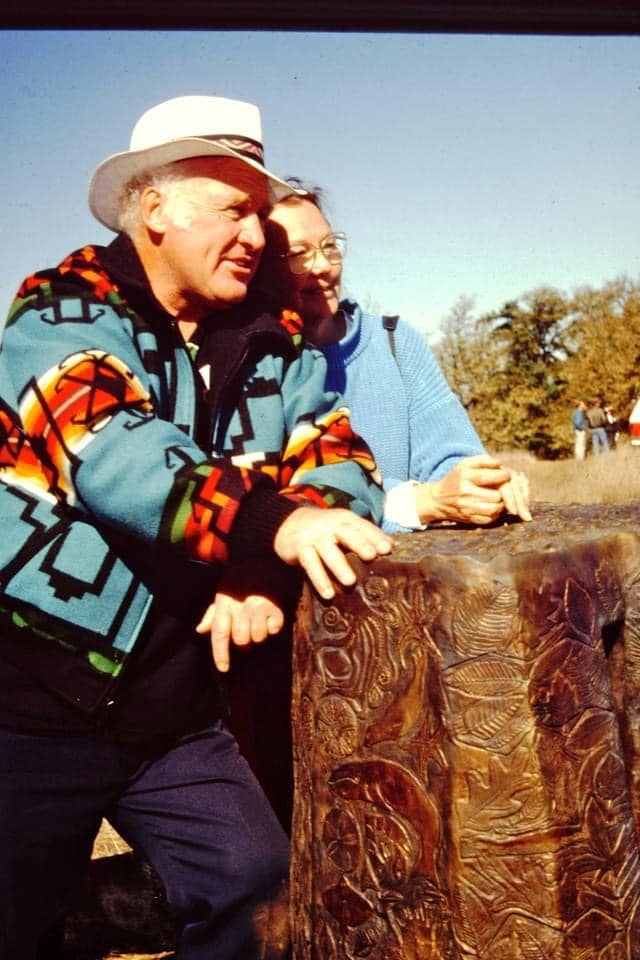
Here is the story of how the Mt. Pisgah Sighting Pedestal came to be. Thanks to artist (and friend) Pete Helzer - Zane Kesey
The Mt. Pisgah Sighting Pedestal by Pete Helzer
This October marks the 30... View MoreHere is the story of how the Mt. Pisgah Sighting Pedestal came to be. Thanks to artist (and friend) Pete Helzer - Zane Kesey
The Mt. Pisgah Sighting Pedestal by Pete Helzer
This October marks the 30th anniversary of the bas-relief sculpture at the summit of Mt. Pisgah. The sculpture has been the subject of articles in newspapers and magazines from The New York Times to the Oregon Quarterly, largely because of its association with author Ken Kesey. Sometimes these articles refer to the sculpture as the Mt. Pisgah Memorial, or the Kesey Memorial. Ken Kesey, who commissioned the project, called it the Mt. Pisgah Sighting Pedestal.
Over the last thirty years, I’ve led hikes to the summit of Mt. Pisgah where I gave presentations on various features of the pedestal, including plate tectonics, Oregon fossils, and the summer and winter solstice. When people would ask what inspired the idea for the sculpture, my answers were usually brief and vague, in part because I wanted the focus to be on the sculpture rather than the person who made it. Today, that reason seems a bit trite because it’s a legitimate question and it deserves an answer. I’ve traced the origin of my idea to an experience that I had many years ago.
The year was 1952 and the setting was the top of Red Hill near the Hancock Field Station some eighteen miles west of the town of Fossil, Oregon. I was one of fourteen boys selected by OMSI to spend two weeks helping Lon Hancock meticulously excavate fossils using icepicks, hand trowels, and whiskbrooms. On the morning of our last day, Mr. Hancock gathered us together just as the morning sun was breaking across the landscape. We gazed down at the rolling hills, crested with rimrock and covered in sagebrush and juniper, while he talked about geologic time. He asked us to imagine what it would be like to look down - not on sagebrush and dust devils - but on a vast forest of Dawn Redwood, or tropical marshes, or a land of palm and peach trees. It was my introduction to the law of superposition, the idea that when we dig through strata, the most recent layers are at the top, and the deeper we dig, the older they get. He compared the strata of the earth to chapters in a book, in our case, a book we read backwards, last chapter first. Three decades later I would hear this theme again.
In February of 1984 Ken Kesey presented a proposal to the Lane County Commissioners and the Superintendent of Parks to install a bronze sighting pedestal at the summit of Mt. Pisgah. The pedestal was to commemorate Jed Kesey and Lorenzo West, two members of the University of Oregon wrestling team who lost their lives in a traffic accident. In the spring of that year, after I was awarded the commission, Ken Kesey and I hiked to the summit of Mt. Pisgah to discuss the pedestal in more detail. As we were looking north toward Mary’s Peak, Ken started to ponder how the view might have changed over time. Ken wondered if the Missoula Floods, which swept across Washington and Oregon at the end of the last ice age, would have been visible from our vantage point. He was imagining what it would be like to look north onto a vast stretch of water filling the Willamette Valley from the Cascade foothills to the Coast Range. It was an exercise in imaginatively engaging an ever-changing landscape, following the story of the earth through time. Whatever terms one chooses to describe the experience: Sacred Awe (Nikos Kazantzakis) or a Sense of Wonder (Rachel Carlson), such musings lend perspective to our lives. I was fortunate to listen to the same reverent musings from two extraordinary men separated by two hundred miles and thirty-two years.
Ken Kesey envisioned a sighting pedestal similar to the one at Dee Wright Observatory in the lava fields of the McKenzie Pass. All sighting pedestals function as a device to help orient us within a particular viewshed. My contribution was to expand the idea of orientation to include geologic time. In order to prepare myself for this project, I spent two years shadowing every geology professor I could find. I sat through a term of Geology of Oregon at the UO, read books on paleontology, and spent countless hours sketching from the Condon Collections at the Museum of Natural and Cultural History. Bill Orr, author of Fossils of Oregon (with illustrations by Elizabeth Orr), was extremely helpful. Botanist David Wagner counseled me through the evolution of botanicals as represented in the Oregon fossil record, as did my wife Marge Helzer, who bears the weighty title of paleoethnobotanist.
My idea was to visually represent two hundred million years of Oregon geologic history starting with conodonts, corrals, and ammonoids. All of the illustrations on the pedestal represent fossils found in Oregon, some as near as the ground beneath the University of Oregon and the road cut along I-5 near Goshen. The botanicals range from tree ferns, ginkgo, and joint grass, to plants still seen in our landscapes of today. Three hundred species, merely a sample of Oregon’s rich fossil record, are represented; about a third of them are now extinct. Since Oregon has over three hundred miles of coastline, I dedicated a couple of panels to marine fossils. These range from microscopic diatoms and radiolarians to a primitive baleen whale with vestigial teeth.
The overall shape of the pedestal was designed to resemble columnar basalt as a way to acknowledge the volcanic origins of Mt. Pisgah some thirty-three million years ago. The slots between the columns are designed to line up with the sunrise and sunset at the summer and winter solstice. The pedestal was cast into bronze in fifty separate pieces, meticulously welded together by Rick Sprague of Pleasant Hill, and installed in the fall of 1990 by Lane County Parks.
The sighting pedestal was not intended as an artistic statement. I hoped it would serve as an invitation to reflect on the dynamic and ephemeral nature of landscapes through time and space. I still remember Kesey’s words when he viewed the pedestal for the first time. He acknowledged that there would be a range of interpretations, then speaking for himself, he said, “It’s about the impermanence of life, and the infinity on either side of it.”
Happy National Fungi Day!!!
In December 1960 Allen Ginsberg and Peter Orlovsky arrived at Timothy Leary's house in Newton, MA. Although Ginsberg was a veteran of psychedelic trips, he had never tried... View MoreHappy National Fungi Day!!!
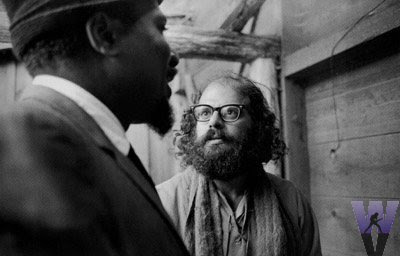
In December 1960 Allen Ginsberg and Peter Orlovsky arrived at Timothy Leary's house in Newton, MA. Although Ginsberg was a veteran of psychedelic trips, he had never tried psilocybin, so when the opportunity presented itself he and Orlovsky jumped at it. The environment provided by Leary was much more congenial than the research institute in Palo Alto where Ginsberg had taken LSD the previous year. After swallowing the mushroom pills, Ginsberg became slightly nauseous, but his initial queasiness subsided as the drug took command of his being. He and Orlovsky were completely overwhelmed. They took off their clothes and padded around the house, a supernatural gleam in their eyes. Ginsberg was inundated by a rush of messianic feelings. "We're going to teach people to stop hating.... Start a peace and love movement," he triumphantly proclaimed..
Ginsberg had some forthright ideas about what to do with the synthetic mushroom. As far as he was concerned, psilocybin had vast implications far beyond the world of medicine; psychedelic drugs held the promise of changing mankind and ushering in a new millennium and therefore no one had the right to keep them from the average citizen.
Whereas Aldous Huxley had suggested turning on opinion leaders, Ginsberg, the quintessential egalitarian, wanted everyone to have the opportunity to take mind-expanding drugs. His plan was to tell everything, to disseminate as much information as possible. The time was ripe to launch a psychedelic crusade--and what better place to start than Harvard University, the alma mater of president-elect John F. Kennedy! Leary seemed ideally suited to lead such a campaign. A respected academic, he had short hair, wore button-down shirts, and took his role as a scientist quite seriously. How ironic, Ginsberg noted, "that the very technology stereotyping our consciousness and desensitizing our perceptions should throw up its own antidote....Given such historic Comedy, who should emerge from Harvard University but the one and only Dr. Leary, a respectable human being, a worldly man faced with the task of a Messiah." Ginsberg pulled out his little black address book and began reeling off the names of people they could turn on: painters, poets, publishers, musicians, and so on. In addition to being one of the most important poets of his time, Ginsberg was a cultural ambassador of sorts. He traveled in various circles, and his contacts were international in scope. He would carry the message to everyone he knew. He retumed to New York armed with a stash of psilocybin. At the Five Spot in Greenwich Village he gave the mushroom pills to Theolonius Monk, the great jazz pianist. A few days later Ginsberg dropped by Monk's apartment to check on the results. Monk peered out from behind a crack in the door, smiled, and asked if he had anything stronger. Ginsberg also turned on Dizzy Gillespie, who was evidently quite pleased by the gesture. "Oh yeah," he laughed, "anything that gets you high."
In a sense it was Ginsberg's way of returning a historical favor: the jazz musicians had given marijuana to the beats, and now the beats were turning the iazz cats on to psychedelics. Word of the new drugs spread quickly through the jazz scene, and numerous musicians, including many of the preeminent players in the field, experimented with psychedelics in the early l960s. John Coltrane, the acknowledged master of the tenor saxophone, took LSD and reported upon returning from his inner voyage that he "perceived the inter-relationship of all life forms."
Jack tries Mescaline in October and October 7, 1960 Kerouac had the opportunity to try Ayahuasca
In the period surrounding both the events depicted in Big Sur and the writing and editing of the book,... View MoreJack tries Mescaline in October and October 7, 1960 Kerouac had the opportunity to try Ayahuasca
In the period surrounding both the events depicted in Big Sur and the writing and editing of the book, Jack actively experimented with certain psychedelic substances that hadn’t yet made a large impression on the American culture: mescaline, ayahuasca, and psilocybin mushrooms. At the start of Big Sur, he mentions some of these substances in a slightly negative manner, as if to suggest that they had worsened his overall mental condition: “. . . ‘One fast move or I’m gone,’ I realize, gone the way of the last three years of drunken hopelessness which is a physical and spiritual and metaphysical hopelessness you cant learn in school no matter how many books on existentialism or pessimism you read, or how many jugs of vision-producing Ayahuasca you drink, or Mescaline take, or Peyote goop up with—” (4).
However, this can’t be the whole story, since Kerouac’s letters offer an entirely different view on his psychonautic exploration during this time. Jack first tried mescaline in October 1959 (5), and he was apparently most open about it with Allen Ginsberg, to whom he wrote the following on June 20, 1960: “When on mescaline I was so bloody high I saw that all our ideas about a ‘beatific’ new gang of worldpeople, and about instantaneous truth being the last truth. Etc. etc. I saw them as all perfectly correct and prophesied, as never on drinking or sober I saw it — Like an Angel looking back on life sees that every moment fell right into place and each had flowery meaning…” (6). This kind of clarity must have been cherished by a guy who saw his life as a long chain of rambling misadventures. Kerouac was even moved to create a 5,000-word “Mescaline Report” in order to document his hallucinations and revelations. He said he intended to take mescaline monthly, and he couldn’t wait to test out LSD (lysergic acid diethylamide). In the same letter Kerouac mentioned his intention to flee New York, shortly before Ferlinghetti suggested that Jack use his cabin as an escape. The actual trip lasted about two months, from mid-July to mid-September 1960.
After returning from California, Kerouac had the opportunity to try ayahuasca on October 7, 1960 (7). Ginsberg had just visited South America and brought back some of the liquid preparation, also known as “yagé” (pronounced “yah-hey,” but they usually misspelled it as “yage”). William S. Burroughs had done the same in the early 1950s, as documented in his fictionalized letters titled “In Search of Yage” (written in ’53 but not published until ’63). Kerouac seems to have tasted the real thing, since, according to Ginsberg (writing during the event), Jack remarked, “This is one of the most sublime or tender or lovely moments of all our lives together . . .” (????. That’s not to say the experience was only positive. In June 1963 Jack reflected to Allen that, when he would wander into Manhattan for drinking binges, “I come back [to Long Island] with visions of horror as bad as Ayahuasca vision on the neanderthal million years in caves, the gruesomeness of life!” (9).
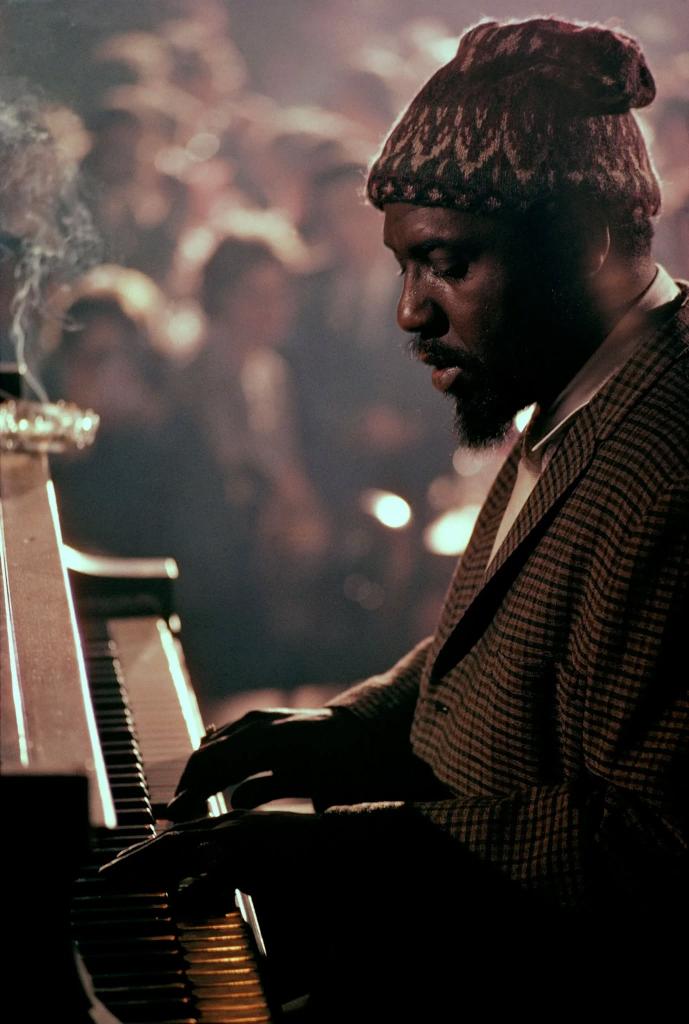
Thelonious Sphere Monk October 10,1917 – February 17,1982Jazz music started doing acid long before the rock stars of the late sixties. Dizzy Gilespie, Charles Mingus, John Coltrane, and Thelonious Mon... View MoreThelonious Sphere Monk October 10,1917 – February 17,1982Jazz music started doing acid long before the rock stars of the late sixties. Dizzy Gilespie, Charles Mingus, John Coltrane, and Thelonious Monk were all trying psychedelics long before Janis Joplin, Jimi Hendrix, or Donovan came along.Psychedelics in jazz came from a number of sources. Zoot Sims picked up his LSD from reverb virtuoso Sandy Bull. Philosopher Gerald Heard was the main supplier for the West Coast Jazz scene. Michael Hollingshead provided LSD to Maynard Ferguson. Timothy Leary provided psilocybin to Dizzy Gillespie. Allen Ginsberg provided Thelonious Monk with both psilocybin and LSD.“A few days later Ginsberg dropped by Monk’s apartment to check on the results,” said Martin A. Lee. “Monk peered out from behind a crack in the door, smiled, and asked if he had anything stronger. Ginsberg also turned on Dizzy Gillespie, who was evidently quite pleased by the gesture. ‘Oh yeah,’ he laughed, ‘antyhing that gets you high.’ In a sense it was Ginsberg’s way of returning historical favor; the jazz musicians had given marijuana to the beats, and now the beats were turning the jazz cats on to psychedelics. Word of the new drugs spread quickly through the jazz scene, and numerous musicians, including many of the preeminent players in the field, experimented with psychedelics in the early 1960s. John Coltrane….”[iii]Tenor sax player Charlie Rouse and Thelonious Monk were playing at the Jazz Workshop in Boston when Timothy Leary paid them his first visit in 1961. He came backstage and provided them both with psilocybin pills. Word began to spread to other jazz musicians. When you’re in Boston - try this guy.Monk followed up in August 1962, asking for LSD. Leary referred him to Ginsberg while Monk was booked at the Village Gate. His opening act was Hugh Romney, an acid head comedian who later became famous at Woodstock as Wavy Gravy.By Showbiz Imagery and Forgotten History
September 24, 1967 Human Be-In held in City Park, Denver
The Day the Grateful Dead, Timothy Leary and LSD Turned On City Park
Steve Rubick, who’s seen the Grateful Dead numerous times, remembers whe... View MoreSeptember 24, 1967 Human Be-In held in City Park, Denver
The Day the Grateful Dead, Timothy Leary and LSD Turned On City Park
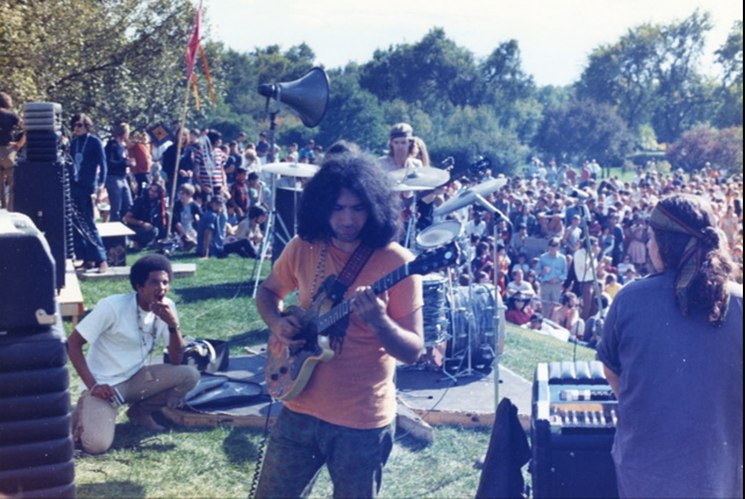
Steve Rubick, who’s seen the Grateful Dead numerous times, remembers when Timothy Leary came to the Mile High City five decades ago and announced that the Dead would be playing at City Park, just a few blocks from one of Denver's underground LSD labs.
“When [Leary] was asked what he was doing in Denver, he said, ‘I heard there was a shortage of LSD,’” Rubick remembers. “And that was broadcast that night on the evening news. At that time, LSD was legal. They did an acid test in front of the fountain. The Grateful Dead set up right in front of the steps of the Natural History Museum.”
This was on Sunday, September 24, 1967, at the Human Be-In, a celebration of ’60s counterculture (a flier for the event promised “beads, bells, incense, flowers, food and other trippy things”); another Human Be-In had been held at Golden Gate Park in San Francisco earlier that year. The Dead had played its first Denver shows the previous two nights at the newly opened Family Dog. Along with the Dead, the City Park Human Be-In featured an altitude-sick Captain Beefheart, Mother Earth, Tracy Nelson, Lothar and the Hand People and Crystal Palace Guard.
Rubick remembers that it was a beautiful day in City Park, with a lot of naked people frolicking in the fountain and everybody having a great time. The Denver Post reported that about 5,000 people had gathered; “some came to dance, some came to sing, some came to love, some came to watch, and a few came to just be there,” the paper said.
Near the end of the event, Leary asked everyone to chant the single syllable “om,” which he explained had meant “the sound of the sun, the hum of the seed and the message that the electron murmurs to the proton” for many centuries. According to the Post, Leary also asked the crowd to “look around and see the lawn and grass in City Park is in the state the great process of nature would have it. In other words, tune in, turn it on, drop out, and clean up.”
Today Rubick considers the Dead one of the greatest bands ever, but he was just starting to get into the act back in 1967. “They were kind of a novelty,” he remembers. “The whole scene was just in its infancy back then. The City Park show in Denver, for me, personally, was one of the first kind hippie events that I ever saw.”
On Travels in the Universe of the Soul:Reports on Self-Experiments withDelysid (LSD) and Psilocybin (CY)tRUDOLF GELPKE •https://www.samorini.it/doc1/alt_aut/ek/gelpke-travels-universe-soul-lsd-psilocy... View MoreOn Travels in the Universe of the Soul:Reports on Self-Experiments withDelysid (LSD) and Psilocybin (CY)tRUDOLF GELPKE •https://www.samorini.it/doc1/alt_aut/ek/gelpke-travels-universe-soul-lsd-psilocybin.pdf
page=1&callback_module_id=groups&callback_item_id=532&year=&month=
View More